

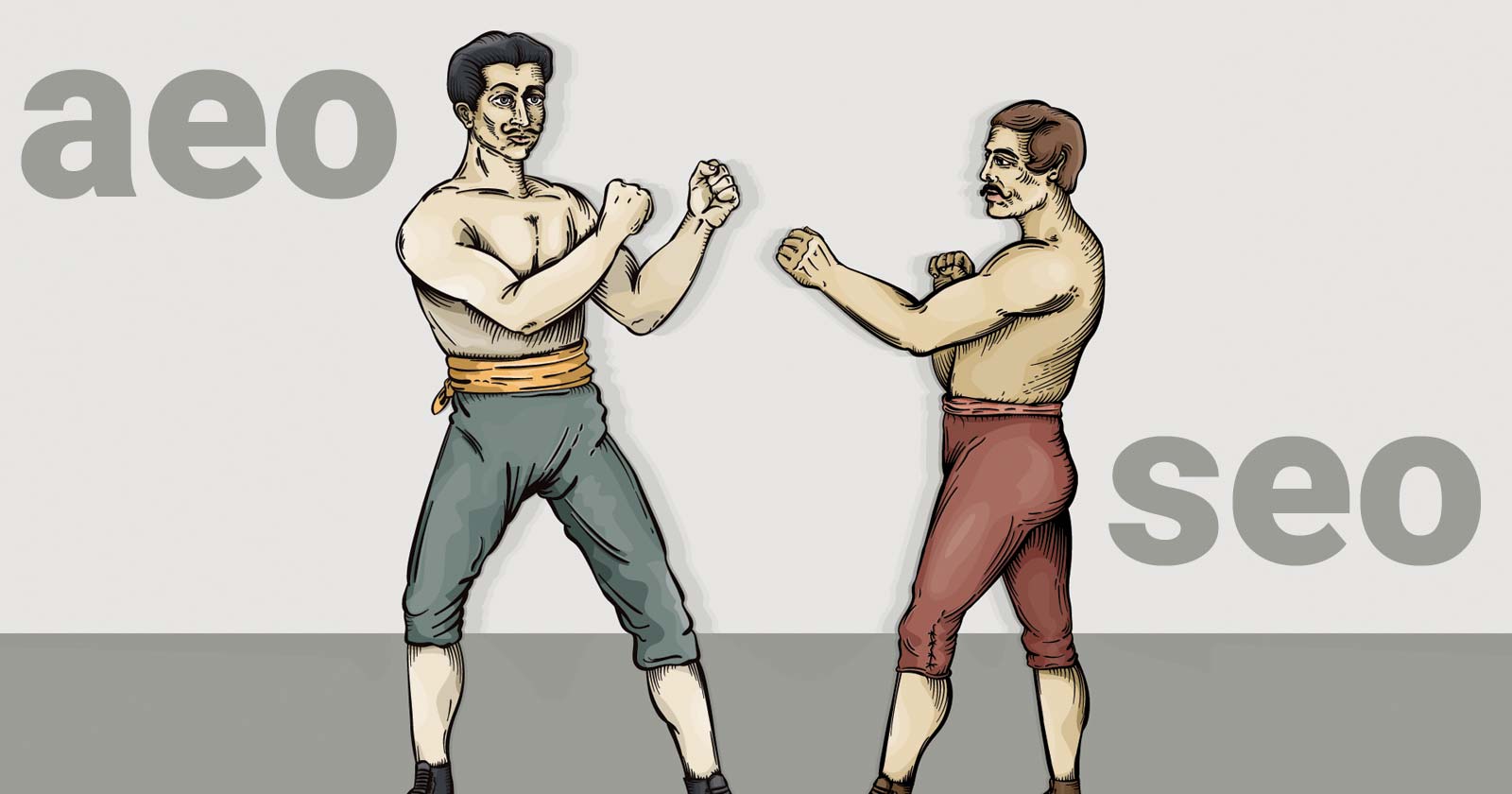
The debate about AEO/GEO centers on whether it’s a subset of SEO, a standalone discipline, or just standard SEO. Deciding on where to plant a flag is difficult because every argument makes a solid case. There’s no doubt that change is underway and it may be time find where all the competing ideas intersect and work from there.
The Case Against AEO/GEO
Many SEOs argue that AEO/GEO doesn’t differentiate itself enough to justify being anything other than a subset of SEO, sharing computers in the same office.
Harpreet Singh Chatha (X profile) of Harps Digital recently tweeted about AEO / GEO myths to leave behind in 2025.
Some of what he listed:
- “LLMs.txt
- Paying a GEO expert to do “chunk optimization.” Chunking content is just making your content readable.
- Thinking AEO / GEO have nothing in common with SEO. Ask your favourite GEO expert for 25 things that are unique to AI search and don’t overlap with SEO. They will block you.
- Saying SEO is dead. “
The part about LLMs.txt being a myth is rooted in the fact that no AI search engine currently uses the markdown. SEOs and publishers cannot be trusted with a separate markdown for AI because let’s be honest, we all know it will be manipulated for AI ranking, forcing AI search to check it against the regular HTML content, undermining any convenience inherent in markdown files.
Another reason for the anti-GEO backlash is that there is a small but loud group of pro-GEO/AEO agencies and individuals who have very little experience with SEO pushing solutions that are, at best, just SEO and, at worst, spammy tactics. It’s not lost on the SEO community that some of the loudest voices are fresh out of college and have zero experience.
The legendary Greg Boser (LinkedIn profile), one of the founders of SEOs since 1996 tweeted this:
“At the end of the day, the core foundation of what we do always has been and always will be about understanding how humans use technology to gain knowledge.
We don’t need to come up with a bunch of new acronyms to continue to do what we do. All that needs to happen is we all agree to change the “E” in SEO from “Engine” to “Experience”.
Then everyone can stop wasting time writing all the ridiculous SEO/GEO/AEO posts, and get back to work.”
Inability To Articulate AEO/GEO
What contributes to the perception that AEO/GEO is not a real thing is that many proponents of AEO/GEO fail to differentiate it from standard SEO. We’ve all seen it where someone tweets their new tactic and the SEO peanut gallery chimes in, nah, that’s SEO.
Back in October Microsoft published a blog post about optimizing content for AI where they asserted:
“While there’s no secret strategy for being selected by AI systems, success starts with content that is fresh, authoritative, structured, and semantically clear.”
The post goes on to affirm the importance of SEO fundamentals such as “Crawlability, metadata, internal linking, and backlinks” but then states that these are just starting points. Microsoft points out that AI search provides answers, not ranked list of pages. That’s correct and it changes a lot.
Microsoft says that now it’s about which pieces of content are being ranked:
“In AI search, ranking still happens, but it’s less about ordering entire pages and more about which pieces of content earn a place in the final answer.”
That kind of echoes what Jesse Dwyer of Perplexity AI recently said about AI Search and SEO:
“As for the index technology, the biggest difference in AI search right now comes down to whole-document vs. “sub-document” processing.
…The AI-first approach is known as “sub-document processing.” Instead of indexing whole pages, the engine indexes specific, granular snippets (not to be confused with what SEO’s know as “featured snippets”).”
Microsoft recently published an explainer called “From discovery to influence:A guide to AEO and GEO” that’s tellingly focused mostly on shopping, which is notable and remarkable because there’s a growing awareness that ecommerce stands to gain a lot from AI Search.
No such luck for informational sites because it’s also gradually becoming understood that Agentic AI is poised to strip informational sites of all branding and value-add and treating them as sources of data.
See also: Stop Trying To Make GEO Happen
Common SEO Practices That Pass As GEO
Some of what some champion as GEO and AEO are actually longstanding SEO practices:
- Crafting content in the form of answers
Good SEOs have been doing this since Featured Snippets came out in 2014. - Chunking content
Crafting content in tight paragraphs looks good in mobile devices and it’s something good SEOs and thoughtful content creators have been doing for well over a decade. - Structured Content
Headings and other elements that strongly disambiguate the content are also SEO. - Structured Data
Shut your mouth. This is SEO.
Turn Your Back On Customer Demand?
Some of in the GEO Is Real camp tend to regard themselves as evolving with the times but they also acknowledge they’re just offering what the clients are demanding. SEO practitioners are in a hard spot, what are you going to do? Plant your flag on traditional SEO and turn your back on what potential clients are begging for?
Many in SEO already acknowledge that yes, there is some difference in how websites are cited and ranked. Leaving aside the low-quality listicle crowd, some of what’s offered as AI-ready is still SEO.
- Content Clarity
- Structured content
- Structured data
- Semantic SEO
- FAQs
- Freshness
- Citations from other sites.
It looks so much like SEO, right?
Except that last one, Citations. Getting cited by authoritative sites in order to get others to affirm your site and have that surfaced in AI search is almost new. This is a bright spot for authoritative information sites because currently all AI search and chat rank sponsored content that is fully FTC compliant and contain the Google-friendly nofollow attribute.
Googlers Insist It’s Still SEO
There are Googlers such as Robby Stein (VP of Product), Danny Sullivan, and John Mueller who say that SEO is 100% still relevant because under the hood AI is just firing off Google searches for top ranked sites to backfill into synthesized answers and links (Read: Google Downplays GEO – But Let’s Talk About Garbage AI SERPs). OpenAI was recently hiring a content strategist that is able to lean into to SEO (not GEO), which some say demonstrates that even OpenAI is focused on traditional SEO.
See also: Google Says You Don’t Need AEO Or GEO To Rank In AI Overviews
Optimization Is No Longer Just Google
Manick Bhan (LinkedIn profile), founder of the Search Atlas SEO suite, offered an interesting take on why we may be transitioning to a divided SEO and GEO path.
Manick shared:
“SEO has always meant ‘search engine optimization,’ but in practice it has historically meant ‘Google optimization.’ Google defined the interface, the ranking paradigm, the incentives, and the entire mental model the industry used.
The challenge with calling GEO a ‘sub-discipline’ of SEO is that the LLM ecosystem is not one ecosystem, and Google’s AI Mode is becoming a generative surface itself.”
Manick asserts that there is no one “GEO” because each of the AI search and answer engines use different methodologies. He observed that the underlying tactics remain the same but the “the interface, the retrieval model, and the answer surface” are all radically changed from anything that’s come before.
Manick believes that GEO is not SEO, offering the following insights:
“My position is clear: GEO is not just SEO with a fresh coat of paint, and reducing it to that misses the fundamental shift in how modern answer engines actually retrieve, rank, and assemble information.
Yes, the tactics still live in the same universe of on-page and off-page signals. Those fundamentals haven’t changed. But the machines we’re optimizing for have.
Today’s answer engines:
- Retrieve differently,
- Fuse and weight sources differently,
- Handle recency differently,
- Assign trust and authority differently,
- Fan out queries differently,
- And incorporate user behavior into their RAG corpora differently.
Even seemingly small mechanics — like logit calibration and temperature — produce practically different retrieval outputs, which is why identical prompts across engines show measurable semantic drift and citation divergence.
This is why we’re seeing quantifiable, repeatable differences in:
- Retrieved sources,
- Answer structures,
- Citation patterns,
- Semantic frames,
- And ranking behavior across LLMs, AI Mode surfaces, and classical Google results.
In this landscape, humility and experimentation matter more than dogma. Treating all of this as ‘just SEO’ ignores how different these systems already are, and how quickly they’re evolving.”
The Clarity In GEO, AEO, And SEO
The reason this debate feels unresolved is because the industry is arguing taxonomy while the underlying systems are mid-transition. The clarity many are searching for is not going to come from naming what is new, which explains why none of the labels fully fit yet. The lack of clarity is not a failure to define GEO or AEO, but a reflection of how early this transition still is.
There is no distinct GEO playbook. But there are measurable differences in retrieval, citation, and answer synthesis. The mere fact that an answer is delivered in natural language is the key differentiator on the output side, and on the input side, that reality brings clarity to what matters most in content: clear answers and stronger contextual awareness so information can function as a cited or synthesized passage.
The clarity in the debate over SEO and GEO comes from recognizing that dismissing GEO as imaginary while simultaneously conceding that “something is different” avoids acknowledging that those differences are already shaping how content is selected and used, even if many of the underlying practices should have always been part of good SEO. That clarity also requires acknowledging that treating GEO or AEO as a settled discipline assumes a level of stability that does not yet exist.
The real clarity is understanding that optimization is no longer aimed at a single system or surface and that what we call SEO is in transition.
Featured Image by Shutterstock/Natsmith1